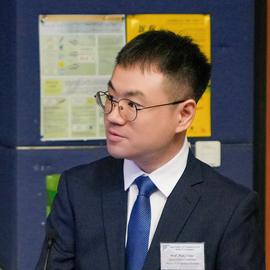
Prof Victor Pan and Dahoon Kim (김다훈/金多勳) published "Discourse particles in Korean - phasehood and derivation" in Journal of Linguistics!
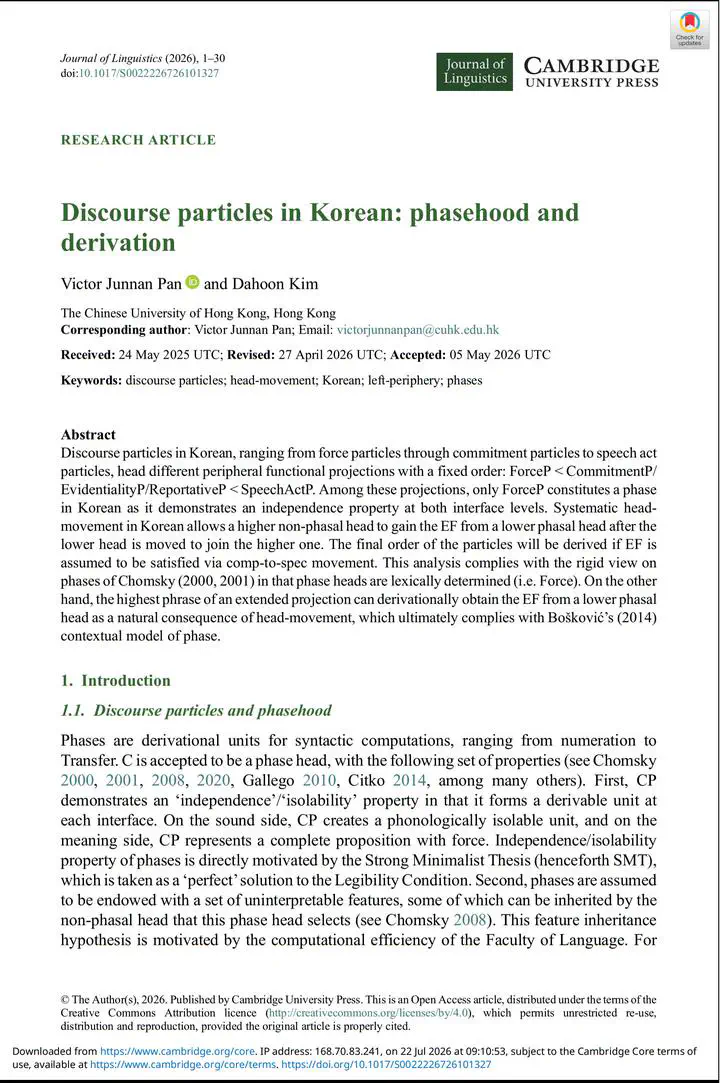
Prof Victor Pan and Dahoon Kim (김다훈/金多勳) (former RA in our team, now PhD student at UCSC) published Discourse particles in Korean: phasehood and derivation in Journal of Linguistics (SSCI, AHCI) (open access)!
Abstract Discourse particles in Korean, ranging from force particles through commitment particles to speech act particles, head different peripheral functional projections with a fixed order: ForceP < CommitmentP/EvidentialityP/ReportativeP < SpeechActP. Among these projections, only ForceP constitutes a phase in Korean as it demonstrates an independence property at both interface levels. Systematic head-movement in Korean allows a higher non-phasal head to gain the EF from a lower phasal head after the lower head is moved to join the higher one. The final order of the particles will be derived if EF is assumed to be satisfied via comp-to-spec movement. This analysis complies with the rigid view on phases of Chomsky (2000, 2001) in that phase heads are lexically determined (i.e. Force). On the other hand, the highest phrase of an extended projection can derivationally obtain the EF from a lower phasal head as a natural consequence of head-movement, which ultimately complies with Bošković’s (2014) contextual model of phase.
Keywords: discourse particles, head-movement, Korean, left-periphery, phases